
| | E-MAIL | |  |
 |
 |
|
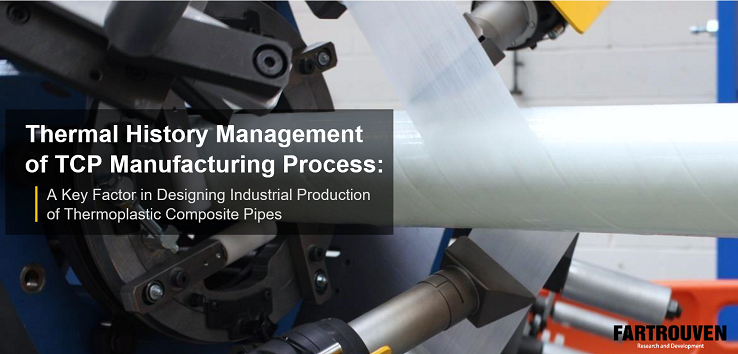
Thermal History Management A TCP manufacturing complex should be designed around the physical processes occurring in the material, rather than around technological operations |
Thermal History Management of TCP Manufacturing Process
Authors: Michael Popov, Nelson Bernardo (Fartrouven R&D)
| Download the printable PDF version |
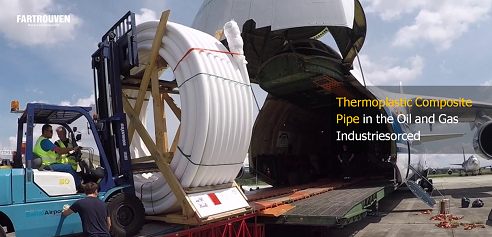
. Abstract Fully bonded Thermoplastic Composite Pipe (TCP) technology is emerging as one of the most promising directions in the development of pipeline systems for the oil and gas industry, hydrogen energy, chemical processing and other applications requiring high levels of reliability, durability and corrosion resistance. This article provides a comparative analysis of one-stage, two-stage and three-stage TCP manufacturing processes, examining their advantages, limitations and influence on the formation of the composite pipe structure. It shows that the development of TCP technology is driven not simply by increasing the complexity of production lines, but by the need to independently control the physical processes taking place within the material at different stages of manufacturing. Based on this analysis, the article introduces the concept of Thermal History Management of TCP Manufacturing Process, which considers the manufacturing complex as a system for controlling the sequence of thermal and thermomechanical processes involved in forming the composite pipe structure. The article also formulates principles for designing next-generation TCP manufacturing complexes based on a transition from designing individual technological operations to designing controlled material-forming processes. The article is intended for specialists in composite pipe manufacturing, developers of production equipment, engineers involved in the design of TCP manufacturing complexes, and companies considering the establishment of their own thermoplastic composite pipe production facilities.
Why TCP Is Not Simply a Reinforced Plastic Pipe
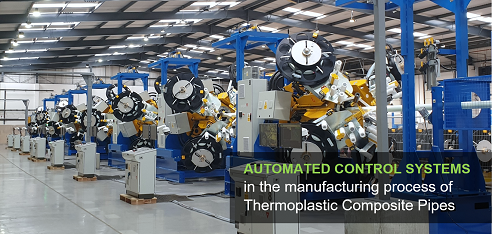
The development of Thermoplastic Composite Pipe (TCP) technology is opening new opportunities in the oil and gas industry, hydrogen energy, chemical processing and infrastructure projects. However, TCP manufacturing is still sometimes approached as a relatively simple process of wrapping composite tape around a plastic pipe.
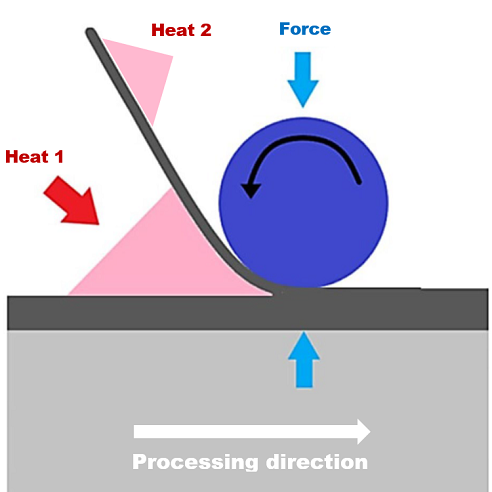
In reality, industrial TCP manufacturing is a complex process for forming a fully bonded composite structure in which each layer undergoes its own thermomechanical history. The final performance of the pipe is determined not by individual manufacturing operations, but by the combined effects of heating, consolidation, crystallization, shrinkage, relaxation and cooling throughout the entire production cycle.
The article demonstrates why traditional criteria for evaluating manufacturing complexes — such as linear production speed, the number of technological operations or the nominal capacity of the equipment — are no longer sufficient for modern TCP production. The authors propose considering the manufacturing complex as a system for controlling the physical processes that form the composite pipe structure and introduce the concept of Thermal History Management of TCP Manufacturing Process as a methodological basis for designing next-generation manufacturing complexes.
Comparison of One-Stage, Two-Stage and Three-Stage TCP Manufacturing Processes
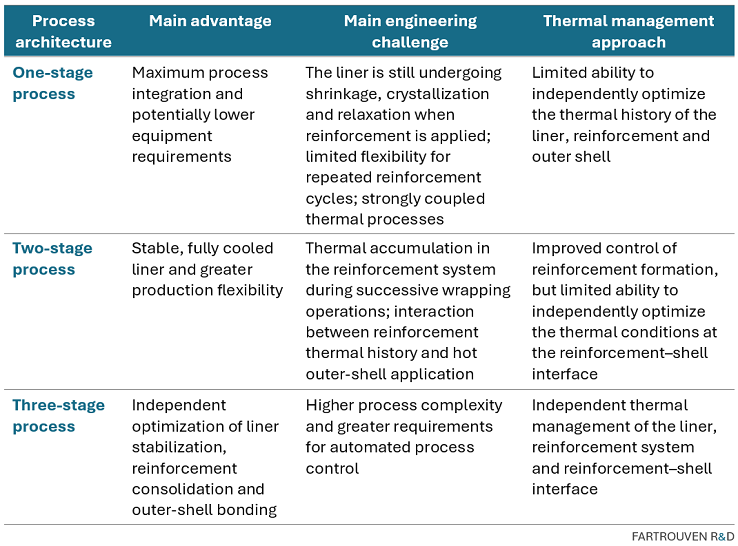
The comparison illustrates the fundamental transition from simply combining technological operations to independently managing the physical processes that determine the structure and properties of the TCP.
A TCP manufacturing complex should therefore be designed not around technological operations, but around the physical processes taking place in the material. This approach enables reproducible formation of a fully bonded composite structure with defined performance characteristics while creating new opportunities to improve product quality, production capacity and manufacturing flexibility.
Thermal History Management of TCP Manufacturing Process
The concept of Thermal History Management of TCP Manufacturing Process represents a transition from viewing the production line as a sequence of extruders, wrapping machines and cooling systems to viewing it as an integrated system for controlling the thermal and thermomechanical history of the composite structure throughout the manufacturing cycle.
The key engineering objective is not simply to achieve a high line speed, but to maintain the required process window for heating, consolidation, cooling, crystallization and stabilization at each stage of composite formation.
This approach makes it possible to optimize the manufacturing process around the actual architecture of the TCP — including pipe diameter, operating pressure, reinforcement material, number of reinforcement layers, number of wrapping machines and required reinforcement cycles — rather than treating equipment capacity as an independent characteristic of the production line.
A TCP manufacturing complex should be designed around the physical processes occurring in the material, rather than around technological operations.
This principle provides the basis for designing manufacturing complexes capable of reproducibly forming fully bonded TCP structures with controlled properties while combining product quality, production capacity and technological flexibility.
© Fartrouven R&D 2026
Consultations
Consulting services on the organisation and development of Thermoplastic Composite Pipe (TCP) manufacturing.
e-mail: plant@fartrouven.pt

PUBLICATIONS
TECHNOLOGIES
FARTROUVEN R&D
.
Rua Campo de Futebol, 308 Ruivaqueira 2425-480 Souto da Carpalhosa, Portugal
www.fartrouven.pt
Portugal +351 244 130 855
CIS countries +7 985 087 40 86
e-mail: geral@fartrouven.pt
© FARTROUVEN R&D PORTUGAL 2012-2026